Exploring the Ancient Temples of Hagar Qim and Mnajdra in Malta
Our recent vacation took us to the stunning island of Malta, where we spent five days soaking in the island’s rich history, culture, and breathtaking landscapes. One of the most unforgettable experiences was visiting the prehistoric megalithic temples of Hagar Qim and Mnajdra. These ancient structures provided us with a deeper connection to Malta’s distant past and are certainly a must-see for anyone visiting the island.
A Journey Back in Time: The History of Hagar Qim and Mnajdra
Hagar Qim and Mnajdra are among the oldest religious sites in the world, with construction dating back to 3600-3200 BCE. These temples predate both the Pyramids of Giza and Stonehenge, making them some of the oldest large-scale structures ever built by humankind. Hagar Qim, which translates to “standing stones” in Maltese, consists of massive stone slabs, some weighing up to 57 tons.
These ancient temples are UNESCO World Heritage sites, renowned for their architectural precision and astronomical alignment. In recent years, they’ve gained additional fame after being featured in the documentary series “Ancient Apocalypse” by Graham Hancock, which shed new light on the mysteries of these monuments.
How to Get to the Temples
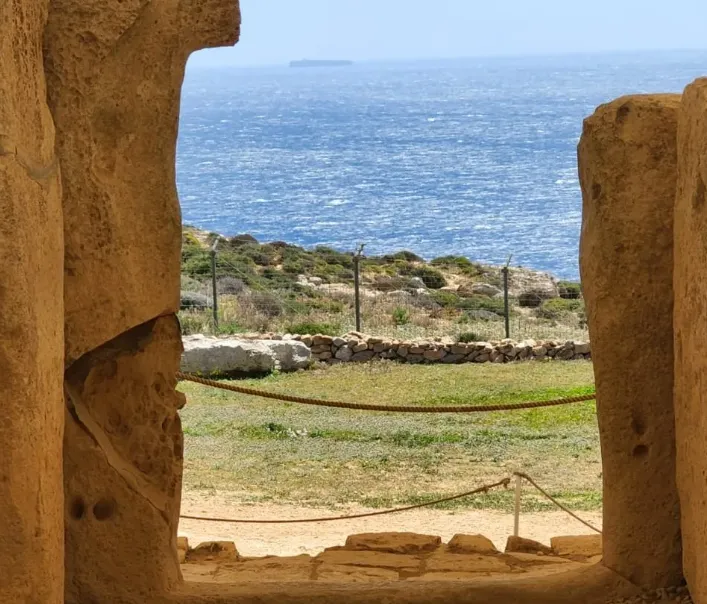
Hagar Qim and Mnajdra are situated on the southern coast of Malta, near the town of Qrendi. The site overlooks the Mediterranean Sea, offering stunning views of the rugged coastline. To get there from St. Julian’s, we took a 20-minute Uber ride, which cost around 10 Euros. Public transport is also an option, as Malta has an extensive bus system that connects major cities and towns.
The archaeological park is located in a tranquil rural area, far from the hustle and bustle of Malta’s more populated regions. After visiting the temples, we also made a short trip to the medieval town of Mdina, which was a fantastic addition to our itinerary.
The Hagar Qim and Mnajdra Archaeological Park
The archaeological park at Hagar Qim and Mnajdra includes a small museum, a movie theater, and a gift shop. Walking paths lead visitors through the site, allowing for a leisurely exploration of the temples and the surrounding landscape. The park’s hiking trails offer incredible views of the coastline, and the area is known for its serene beauty. On the day of our visit, the weather shifted from overcast to sunny, enhancing the experience.
The Museum
Although small, the museum at Hagar Qim provides an informative look at the history of the temple complex. Exhibits detail the archaeological discoveries made over the past two centuries and showcase artifacts found at the site. Interactive displays let visitors engage with the history in fun and educational ways, such as stepping through replicas of temple entrances or using foam blocks to build structures. The museum also highlights the human statues and carvings uncovered at the site, some of which are on display.
The Theater and 3D Movie
In addition to the museum, the park features a modern theater that occasionally shows a 3D movie about the temples. The movie offers a comprehensive overview of the temples’ history, their discovery, and the theories about their purpose. It was an engaging way to deepen our understanding of the site.
Self-Guided Tour
As part of the entrance fee, visitors can access a self-guided tour through an app. This tour uses numbered markers around the site and provides an audio commentary that explains the significance of each stop. We found it to be an excellent way to learn about the temples and their history while exploring the site at our own pace.
The Hagar Qim Temple Complex
The main attraction at Hagar Qim is the temple itself, which consists of several large stone structures. The stones, some of which are several tons in weight, are arranged in a way that creates walls and passages. When originally constructed, the temple was likely covered with a roof made using a technique called “cobelling,” where stones were stacked in a corbel arch style. Though the roof has long since disappeared, the temple’s grandeur still impresses visitors.
A path runs around the perimeter of the temple, giving a close-up view of the immense stones and offering a sense of the monumental effort involved in constructing such a structure. Some of the artifacts found at the site, such as statues and carved stones, are displayed in the museum, while replicas are on display at the temple.
Large tents now cover both the Hagar Qim and Mnajdra temples to protect them from the elements. These tents, constructed in 2008, help preserve the ancient stone structures from the damaging effects of wind, rain, and sun.
The Mnajdra Temple Complex
Located just 500 meters south of Hagar Qim, Mnajdra is another ancient temple site worth exploring. Mnajdra consists of three temples built using a combination of globigerina and coralline limestone. The oldest temple features three apses (curved rooms), while the larger South Temple has a distinctive concave facade. One of the most remarkable aspects of Mnajdra is its astronomical alignment. The doorway of the South Temple is perfectly aligned with the sunrise during the spring and autumn equinoxes. During the solstices, the sun illuminates two decorated stone slabs inside the temple’s first chamber, functioning as an ancient sun tracker.
The complexity of the Mnajdra site, both in its design and its understanding of astronomy, is a testament to the ingenuity of the people who built it thousands of years ago. We enjoyed exploring the ruins and appreciating the site’s historical and cultural significance.
Conclusion
Our visit to Hagar Qim and Mnajdra was an unforgettable experience. The temples offer a fascinating glimpse into Malta’s prehistoric past and the advanced skills of the ancient builders. Whether you’re a history enthusiast or simply someone who enjoys exploring beautiful, off-the-beaten-path locations, these ancient temples should be at the top of your list when visiting Malta.